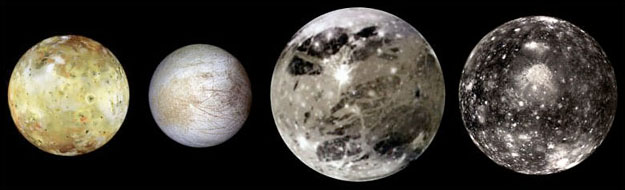
Jupiter's Galilean Moons
Images: Galileo Project, Voyager Project
These four largest and brightest moons of Jupiter, first discovered by Galileo Galilei in 1610, are known as the Galilean satellites. Starting from left to right the moons are Io, Europa, Ganymede, and Callisto. This order is also the order of increasing distance from Jupiter.
These are big moons that attend the largest planet. The smallest of the lot, Europa, is the size of Earth's moon while Ganymede is the largest moon in the Solar System. In fact, Ganymede with a diameter of 3,100 miles, is larger than the planet Mercury. Battered Callisto's image was recorded during the 1979 flyby of Voyager. The other portraits were taken by the Galileo spacecraft, which began exploring the Jovian system in 1995.
Every six years the Earth lies in the orbital plane of Jupiter's moons. At this time Jupiter's 4 bright moons are directly in our line of sight, and the shifting of these moons, one in front of another, plus their shadows crossing the surface of Jupiter grab the attention of those with telescopes. This occurred in 2003, again in 2009 and now in 2015 when Earth moves through the plane of Jupiter's satellites, allowing the moons to line up in their special 6-year geometry.
Between April and December of 2009, observers around the world saw Jupiter's moons passing one in front of another as they circled the giant planet. As part of the International Year of Astronomy, professional astronomers organized a worldwide observing campaign to record as many of these events as possible. See Europa Occults Ganymede and International Year of Astronomy.
High-resolution images of the phenomena are now possible with the vast improvement of imaging techniiques and equipment since 2003.
Watch Europa cccults Ganymede, Ganymede occults Europa and Ganymede Occults Io.
Check out Astro Bob's article about 2015's Once-in-6-Year-Alignment that occurs January through August. Read his Jupiter doesn’t get any better than NOW to learn more about Jupiter and its February 6, 2015 opposition.
Also see Jupiter's 2014-2015 Apparition.
Whenever you think of Jupiter, think "I eat green caterpillars." Why?
Well, with a cheap telescope or even a pair of binoculars you can watch the four largest of Jupiter's 40 moons [67 moons update] as they change position from night to night. They'll look like tiny pinpoints of light although three of them are actually larger than our Moon. Their names are Io, Europa, Ganymede and Callisto and when they're all lined up together on one side of Jupiter the phrase 'I Eat Green Caterpillars' will help you remember their order out from Jupiter. I for Io, E for Europa, G for Ganymede and C for Callisto. It's fun to watch them change position … from night to night. Happy green caterpillaring and Keep Looking Up! Star Gazer
Cartoon: "I Eat Green Caterpillars" ~ Cartoon: The Fun Planet to Watch
Jupiter’s Moons
Sky & Telescope’s JavaScript utility helps
locate Jupiter’s four brightest satellites anytime
between January 1900–December 2100.